




A FILM FESTIVAL WITH MUCH TO SAY
September 12, 2009
VENICE – The film industry’s foremost social critic, Michael Moore,
did not win the Golden Lion at the 66th Venice Film Festival but his documentary ‘Capitalism: A
Love Story’ was the torch bearer of a blunt new cinematographic realism exposing our ailing
societies, our lopsided economies and the reason for poverty in many parts of the world, including the
United States.
While Moore’s meticulously researched ‘I accuse’ left no doubts
American capitalism has turned into a kind of highway robbery by official bandits posing as Robin
Hoods, Oliver Stone’s documentary ‘South of the Border’ leaves little doubt the
greatest barrier to social and economic progress is the mass media – the often ignorant but always
gullible serfs of corporate and official interests.
The two men launched an attack on the twin towers of our capitalist system.
Stone assaulted the media’s demonizing of Latin American leaders like Hugo Chavez and Evo
Morales. Both these leaders stood up to American hegemonic ambitions on their oil and gas resources
and were vilified for it. Moore dismantled a system that is making the few richer, the majority poorer
and he illustrated with interviews how capitalism is now firmly in the hands of Wall Street and the banks
with a complacent Congress rubberstamping their needs rather then the needs of the people.
These two documentaries spearheaded a memorable Film Fest overflowing
with realistic exposes of the world around us, from the slums of Latin America and Asia where people
live on hand-outs, on their wits, the generosity of other poor and the mercy of loan sharks to the
outrageous male chauvinism to which Moslem women are still subjected. There were inside reflections
on the massacres of Tiananmen in 1989 and the stolen election in Teheran last year, to homophobia,
a subject highlighted once again by news of more gay bashings in xenophobic Italy while the films still
ran on the screen in Venice.
As usual political expediency triumphed over merit and the coveted Golden
Lion award went to an Israeli film ‘Lebanon’ by director Samuel Maoz. The film had virtually
nothing to do with Israel’s bloody and periodic incursions into Lebanon but was entirely shot inside
an Israeli tank, marooned on the Lebanese side of the border. The story tells the reaction of its unruly
and panicky crew.
‘Lebanon’ is a fine film, ingeniously shot in the cage-like confines of a
tank which poses the question why Israelis tend to isolate themselves, either in their settlement or in
their tanks. Lebanon carries no message, takes no sides, accuses no one but leaves the viewers with
what they already know – that war is evil and young soldiers really don’t want to die.
From the start of this year’s festival it was obvious the rightwing government
of premier Silvio Berlusconi would go bananas if a ‘leftwing’ film walked off with the prize at an
international Film Fest that had already been ‘persuaded’ to include a record 22 Italian films
among the 80 global entries accepted and had to look on powerless as builders cut down a venerable
old pine grove on its doorstep – to be replaced by concrete structures in some future.
The true color of the powers ruling Italy today emerged when Venezuelan
president Hugo Chavez appeared with Oliver Stone at the premier of ‘South of the Border’ in
which Stone illustrates, with excerpts from US television, how officials and commentators vilified the
democratically (twice) elected Chavez as another Hitler, a despot, a tyrant while they cruelly and
ignorantly dismissed Bolivia’s Evo Morales as a drug addict, hate campaigns far more vitriolic and
contrived then anything the state-run media of the former Soviet Union ever produced.
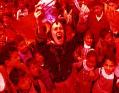
In Venice festival crowds gave a tumultuous welcome to the populist Chavez
whose style may not be everyone’s cup of tea but who has bridged the gap between poor and rich
in his oil-rich nation, a president who brought education and health care to the barrios and rural areas
of Venezuela and who survived a CIA-orchestrated military coup of the kind that killed another
democratically elected Latin American, Salvador Allende, in 1973.
The Berlusconi government completely ignored the presence of Chavez, claiming
it was a private visit. The Festival committee would not even introduce him at the beginning of the film
premier until the crowd shouted ‘Chavez! Chavez! Then the Venezuelan stood up to be
acknowledged. Earlier he had gone on a walk-about to shake hands with common people and to be
photographed with them.
This popular enthusiasm outraged the Berlusconi media which controls 90 per cent
of the Italian press and TV outlets. On its front pages next day it labeled the audiences in Venice ‘a
mob of communists’ for cheering Chavez. (The label ‘communist’ is attached today to
anyone critical of Berlusconi, perhaps a throwback to the nostalgic old fascist days of Il Duce.)
Easily the most impressive film was Moore’s. With gusto and some characteristic
clowning he cobbled together facts and figures illustrating how the few, mainly in America, are living in
Olympian luxury while the multitude have their houses repossessed, their jobs lost, their savings
gobbled up by medical bills and lack of pensions. A year before his death, so the film points out,
President Roosevelt had planned to add to the U.S. constitution a national health scheme and workersâ
€™ rights clauses, innovations never taken off the drawing board.
The president died but after the war Roosevelt officials wrote the new constitutions
for the conquered Axis nations, Germany, Italy and Japan and added to these constitutions Rooseveltâ
€™s ideas, the reason why social welfare schemes like health care, pensions and workers rights now
function in those countries – unlike the United States.
But ruling cliques, whether capitalist or theocratic, cling to their power by subverting
the ideals and practices of democracy for their own ends. This was admirably illustrated in the haunting
Iranian film by Hanna Makhmalbaf ‘Green Days.’ The dramatized documentary dissects the
bloody protests in Teheran following the presidential election last year and shows the eventual winner,
incumbent president Ahmadinejad, came only third in ‘true voting’ but was imposed on the
country by its omnipotent theocracy.
At a time of recession and ongoing wars in Iraq and Afghanistan the films shown in
Venice did not aim - with a few exceptions - for big box office returns but were intend on offering a
message of things gone wrong or providing food for thought about where we are and where we are
going.
Whether it is Corporate Fraud ('The Informant' by Steven Sonderbergh) or the
leftovers of the Cold War, like the harebrain scheme to train soldiers to kill by staring (The Men who
stare at Goats by Grant Heslov) or child trafficking (Tehroun by Takmil Homayoun Nader) the
desire was not to just tell a pretty story but a realistic reflection of current life.
Perhaps the most avant-garde are the Germans whose new crop of films not only
have that amazing mixture of multi-ethnicity that characterizes modern German society today,
especially Berlin where East and Wets merge, but whose new directors are not afraid to exploit fresh
ways of presenting cinematographic art in a kind of neo-surrealism reminiscent of happy-go-lucky
clowns prancing across Alexanderplatz.
One of the best was "Soul Kitchen"by Fatih Akin, a happy-go-lucky, feisty tale of a
young Greek running a restaurant amid an ever changing Berlin and ever changing values. In contrast
Italian films, and there were 22 of them out of 80, remain spectacular but riveted to that durable theme
of fascism versus communism that has divided and still divides Italy. Perhaps the best of the second
week’s Italian crop was Michele Placido’s ‘The Great Dream’ his own experience of a
the 1968 world-wide student rebellion when he was a riot policeman clubbing and informing on the
students before a love affair, not any conviction, made him desert to the other side.
Tom Ford’s ‘A Single Man’ is the tender and sensitive story of a gay
couple, broken up when one dies in a car accident and the other now has to face a world in which he
can not openly mourn, is not invited to the funeral and feels ostracized. He explains to a young student
that homophobia is no more then fear of those who are different.
At a time when Europe tries to keep out the wave of immigrants from Africa and the
war-torn Middle East the story of super-model Waris Dirie gives the audiences a glimpse of what these
immigrants have to suffer to escape not only abject misery, wars and abuses but to find a foothold in
our privileged society determined today to keep them out.
‘Desert Flower’ by Sherry Hormann is Waris’ biography in all its horror
and humanity. A Somalian nomad girl in a family of 13, she was subjected to infibulation at the age of
three when a Muslim woman’s genital organs, the clitoris and the labia are cut away with
instruments like kitchen knives so the women will not experience any pleasure in adult life. The wound
is then sown up and the stitches are only removed by the future husband who cuts open her private
parts with a knife or scissors before ‘taking possession’ of her.
The haunting true story of how she escaped to Mogadishu and then as an illiterate maid
to London details many of the horrors to which immigrants in Europe are now subjected under
draconian immigration laws. Waris teaches herself at night school, enters a marriage of convenience to
stay in Britain, becomes a super-model and ends up addressing the U.N. assembly in New York on the
graphic horror of infibulation, a ritual, though outlawed, which is still practiced on an estimated 6,000
girls a day.
For those who like a little tenderness there is ‘Barking Water’ by young
American director Sterling Harjo, the sweet love story of an elderly couple -going home. “I
thought not only young people but old people too have love stories. And I thought it should be told.â
€� Said Harjo, a member of the Seminole and Creek Nation.
Perhaps in that one phrase ‘it should be told’ he summed up the Venice Film
Festival this year.
Ends.
September 12, 2009
VENICE – The film industry’s foremost social critic, Michael Moore,
did not win the Golden Lion at the 66th Venice Film Festival but his documentary ‘Capitalism: A
Love Story’ was the torch bearer of a blunt new cinematographic realism exposing our ailing
societies, our lopsided economies and the reason for poverty in many parts of the world, including the
United States.
While Moore’s meticulously researched ‘I accuse’ left no doubts
American capitalism has turned into a kind of highway robbery by official bandits posing as Robin
Hoods, Oliver Stone’s documentary ‘South of the Border’ leaves little doubt the
greatest barrier to social and economic progress is the mass media – the often ignorant but always
gullible serfs of corporate and official interests.
The two men launched an attack on the twin towers of our capitalist system.
Stone assaulted the media’s demonizing of Latin American leaders like Hugo Chavez and Evo
Morales. Both these leaders stood up to American hegemonic ambitions on their oil and gas resources
and were vilified for it. Moore dismantled a system that is making the few richer, the majority poorer
and he illustrated with interviews how capitalism is now firmly in the hands of Wall Street and the banks
with a complacent Congress rubberstamping their needs rather then the needs of the people.
These two documentaries spearheaded a memorable Film Fest overflowing
with realistic exposes of the world around us, from the slums of Latin America and Asia where people
live on hand-outs, on their wits, the generosity of other poor and the mercy of loan sharks to the
outrageous male chauvinism to which Moslem women are still subjected. There were inside reflections
on the massacres of Tiananmen in 1989 and the stolen election in Teheran last year, to homophobia,
a subject highlighted once again by news of more gay bashings in xenophobic Italy while the films still
ran on the screen in Venice.
As usual political expediency triumphed over merit and the coveted Golden
Lion award went to an Israeli film ‘Lebanon’ by director Samuel Maoz. The film had virtually
nothing to do with Israel’s bloody and periodic incursions into Lebanon but was entirely shot inside
an Israeli tank, marooned on the Lebanese side of the border. The story tells the reaction of its unruly
and panicky crew.
‘Lebanon’ is a fine film, ingeniously shot in the cage-like confines of a
tank which poses the question why Israelis tend to isolate themselves, either in their settlement or in
their tanks. Lebanon carries no message, takes no sides, accuses no one but leaves the viewers with
what they already know – that war is evil and young soldiers really don’t want to die.
From the start of this year’s festival it was obvious the rightwing government
of premier Silvio Berlusconi would go bananas if a ‘leftwing’ film walked off with the prize at an
international Film Fest that had already been ‘persuaded’ to include a record 22 Italian films
among the 80 global entries accepted and had to look on powerless as builders cut down a venerable
old pine grove on its doorstep – to be replaced by concrete structures in some future.
The true color of the powers ruling Italy today emerged when Venezuelan
president Hugo Chavez appeared with Oliver Stone at the premier of ‘South of the Border’ in
which Stone illustrates, with excerpts from US television, how officials and commentators vilified the
democratically (twice) elected Chavez as another Hitler, a despot, a tyrant while they cruelly and
ignorantly dismissed Bolivia’s Evo Morales as a drug addict, hate campaigns far more vitriolic and
contrived then anything the state-run media of the former Soviet Union ever produced.
In Venice festival crowds gave a tumultuous welcome to the populist Chavez
whose style may not be everyone’s cup of tea but who has bridged the gap between poor and rich
in his oil-rich nation, a president who brought education and health care to the barrios and rural areas
of Venezuela and who survived a CIA-orchestrated military coup of the kind that killed another
democratically elected Latin American, Salvador Allende, in 1973.
The Berlusconi government completely ignored the presence of Chavez, claiming
it was a private visit. The Festival committee would not even introduce him at the beginning of the film
premier until the crowd shouted ‘Chavez! Chavez! Then the Venezuelan stood up to be
acknowledged. Earlier he had gone on a walk-about to shake hands with common people and to be
photographed with them.
This popular enthusiasm outraged the Berlusconi media which controls 90 per cent
of the Italian press and TV outlets. On its front pages next day it labeled the audiences in Venice ‘a
mob of communists’ for cheering Chavez. (The label ‘communist’ is attached today to
anyone critical of Berlusconi, perhaps a throwback to the nostalgic old fascist days of Il Duce.)
Easily the most impressive film was Moore’s. With gusto and some characteristic
clowning he cobbled together facts and figures illustrating how the few, mainly in America, are living in
Olympian luxury while the multitude have their houses repossessed, their jobs lost, their savings
gobbled up by medical bills and lack of pensions. A year before his death, so the film points out,
President Roosevelt had planned to add to the U.S. constitution a national health scheme and workersâ
€™ rights clauses, innovations never taken off the drawing board.
The president died but after the war Roosevelt officials wrote the new constitutions
for the conquered Axis nations, Germany, Italy and Japan and added to these constitutions Rooseveltâ
€™s ideas, the reason why social welfare schemes like health care, pensions and workers rights now
function in those countries – unlike the United States.
But ruling cliques, whether capitalist or theocratic, cling to their power by subverting
the ideals and practices of democracy for their own ends. This was admirably illustrated in the haunting
Iranian film by Hanna Makhmalbaf ‘Green Days.’ The dramatized documentary dissects the
bloody protests in Teheran following the presidential election last year and shows the eventual winner,
incumbent president Ahmadinejad, came only third in ‘true voting’ but was imposed on the
country by its omnipotent theocracy.
At a time of recession and ongoing wars in Iraq and Afghanistan the films shown in
Venice did not aim - with a few exceptions - for big box office returns but were intend on offering a
message of things gone wrong or providing food for thought about where we are and where we are
going.
Whether it is Corporate Fraud ('The Informant' by Steven Sonderbergh) or the
leftovers of the Cold War, like the harebrain scheme to train soldiers to kill by staring (The Men who
stare at Goats by Grant Heslov) or child trafficking (Tehroun by Takmil Homayoun Nader) the
desire was not to just tell a pretty story but a realistic reflection of current life.
Perhaps the most avant-garde are the Germans whose new crop of films not only
have that amazing mixture of multi-ethnicity that characterizes modern German society today,
especially Berlin where East and Wets merge, but whose new directors are not afraid to exploit fresh
ways of presenting cinematographic art in a kind of neo-surrealism reminiscent of happy-go-lucky
clowns prancing across Alexanderplatz.
One of the best was "Soul Kitchen"by Fatih Akin, a happy-go-lucky, feisty tale of a
young Greek running a restaurant amid an ever changing Berlin and ever changing values. In contrast
Italian films, and there were 22 of them out of 80, remain spectacular but riveted to that durable theme
of fascism versus communism that has divided and still divides Italy. Perhaps the best of the second
week’s Italian crop was Michele Placido’s ‘The Great Dream’ his own experience of a
the 1968 world-wide student rebellion when he was a riot policeman clubbing and informing on the
students before a love affair, not any conviction, made him desert to the other side.
Tom Ford’s ‘A Single Man’ is the tender and sensitive story of a gay
couple, broken up when one dies in a car accident and the other now has to face a world in which he
can not openly mourn, is not invited to the funeral and feels ostracized. He explains to a young student
that homophobia is no more then fear of those who are different.
At a time when Europe tries to keep out the wave of immigrants from Africa and the
war-torn Middle East the story of super-model Waris Dirie gives the audiences a glimpse of what these
immigrants have to suffer to escape not only abject misery, wars and abuses but to find a foothold in
our privileged society determined today to keep them out.
‘Desert Flower’ by Sherry Hormann is Waris’ biography in all its horror
and humanity. A Somalian nomad girl in a family of 13, she was subjected to infibulation at the age of
three when a Muslim woman’s genital organs, the clitoris and the labia are cut away with
instruments like kitchen knives so the women will not experience any pleasure in adult life. The wound
is then sown up and the stitches are only removed by the future husband who cuts open her private
parts with a knife or scissors before ‘taking possession’ of her.
The haunting true story of how she escaped to Mogadishu and then as an illiterate maid
to London details many of the horrors to which immigrants in Europe are now subjected under
draconian immigration laws. Waris teaches herself at night school, enters a marriage of convenience to
stay in Britain, becomes a super-model and ends up addressing the U.N. assembly in New York on the
graphic horror of infibulation, a ritual, though outlawed, which is still practiced on an estimated 6,000
girls a day.
For those who like a little tenderness there is ‘Barking Water’ by young
American director Sterling Harjo, the sweet love story of an elderly couple -going home. “I
thought not only young people but old people too have love stories. And I thought it should be told.â
€� Said Harjo, a member of the Seminole and Creek Nation.
Perhaps in that one phrase ‘it should be told’ he summed up the Venice Film
Festival this year.
Ends.